Understanding the American Right

The Al Jazeera Effect

The inside story of Egypt's TV wars and how Saudi Arabia could be next.

BY HUGH MILES | FEBRUARY 8, 2011

"Long live Al Jazeera!" chanted Egyptian protesters in Tahrir Square on Feb. 6. Many Arabs -- not least the staff at Al Jazeera -- have said for years that the Arab satellite network would help bring about a popular revolution in the Middle East. Now, after 15 years of broadcasting, it appears the prediction has come true. There is little question that the network played a key role in the revolution that began as a ripple in Sidi Bouzid, Tunisia, and ended up a wave that threatens to wash away Egypt's long-standing regime.

COMMENTS (9)
The Tunisian uprising revealed that the dogma perpetuated by the country's regime -- that it was impregnable and its security services invincible -- was merely propaganda aimed at keeping Tunisia's people subdued. Al Jazeera shared this revelation around the region live and in real time, breaking the spell that had stopped millions of ordinary people from rising up and claiming their legitimate rights. Suddenly change seemed possible everywhere across the Middle East.
"We did not foresee the drama of events, but we saw how events in Tunisia rippled out and we were mindful of the fact [that] things were changing, and so we prepared very carefully," said Al Anstey, managing director of Al Jazeera English. "We sent teams to join our Cairo bureau and made sure that we were covered on the ground in other countries in the region so when the story unfolded we were ready to cover all angles."
Al Jazeera's powerful images of angry crowds and bloody morgues undercut the Egyptian regime's self-serving arguments and stood in sharp contrast to the state-run TV channels, which promoted such a dishonest version of events that some of their journalists resigned in disgust. At least one popular TV talk-show presenter, Mahmoud Saad, was later seen being carried on the shoulders of triumphant demonstrators in Tahrir Square. While Al Jazeera was showing hundreds of thousands of people calling for the end of the regime, Egyptian TV showed humdrum scenes of traffic quietly passing by; when Al Jazeera reported hundreds of people queuing for bread and petrol, Egyptian TV showed happy shoppers with full fridges using footage filmed at an unknown time in the past.
During the uprising in Cairo, the Egyptian government systematically targeted Al Jazeera in an attempt to impede the network's gathering and broadcasting of news. On Jan. 27 Al Jazeera Mubasher, the network's live channel, was dropped by the government-run satellite transmission company, Nilesat. On Jan. 30, outgoing Egyptian Information Minister Anas al-Fiqi ordered the offices of all Al Jazeera bureaus in Egypt to be shut down and the accreditation of all network journalists to be revoked. At the height of the protests, Nilesat broke its contractual agreement with the network and stopped transmitting the signal of Al Jazeera's Arabic channel -- which meant viewers outside Egypt could only follow the channel on satellites not controlled by the Egyptian authorities. To the rescue came at least 10 other Arabic-language TV stations, which stepped in and offered to carry Al Jazeera's content. "They just volunteered," said Souag. "They were not paid, and we thanked them for that."
The next day, six Al Jazeera English journalists were briefly detained and then released, their camera equipment confiscated by the Egyptian military. On Feb. 3, two unnamed Al Jazeera English journalists were attacked by Mubarak supporters; three more were detained. On Feb. 4, Al Jazeera's Cairo office was stormed and vandalized by pro-Mubarak supporters. Equipment was set on fire and the Cairo bureau chief and an Al Jazeera correspondent were arrested. Two days later, the Egyptian military detained another correspondent, Ayman Mohyeldin; he was released after nine hours in custody. The Al Jazeera website has also been under relentless cyberattack since the onset of the uprising.
"The regime did everything they could to make things difficult for us, but they did not succeed," said Souag. "We still had the most comprehensive reporting of the events in Egypt."
After the first few days of the uprising, the Egyptian state media began running an insidious propaganda campaign in an apparent effort to terrorize ordinary Egyptians into staying at home and off the streets. Channel 1 on Egypt state TV issued vague yet alarming warnings about armed thugs trying to infiltrate the protests and later broadcast live phone-ins in which members of the public complained about looting and disorder. It's hard to think of a better way to incite panic in a jittery population, especially because there have been no emergency services in Egypt for days. By the time these garbled and unsubstantiated stories passed through the Egyptian rumor mill, ordinary people would be forgiven for thinking World War III had broken out. Egyptian state media have also issued warnings of international journalists with a "hidden agenda" and accused Al Jazeera of "inciting the people." One supposed "foreign agent" was shown on Egyptian state TV with face obscured, claiming that she had been trained by "Americans and Israelis" in Qatar, where Al Jazeera is based.
But the lid on Pandora's box has been prized open, and undemocratic regimes across the region are now looking over their shoulder at Al Jazeera -- for history shows that where Egypt goes, other Arab countries soon follow. Given Al Jazeera's enormous influence on the Arab street and its electrifying message that Arab dictatorships are, in fact, mortal, it is no wonder dictators and despots across the region have been left feeling rather rattled. There have already been hints of insurrection's ripples in Algeria, Jordan, Yemen, and Bahrain. But could Al Jazeera threaten Saudi Arabia?
Oil- and gas-rich Arab states can use their wealth to address some of the grievances that brought Tunisians and Egyptians onto the streets, but not all. Al Jazeera's home country, however, would appear to be somewhat safe from the wave of unrest. Power in Qatar is traditionally transferred by coup d'état, as in 1995 when the current emir, Sheikh Hamad bin Khalifa al-Thani, seized power from his father Sheikh Khalifa -- but as the world's richest country with a GDP per capita in excess of $145,000, it is highly unlikely to experience revolutionary convulsions about anything besides shopping. The most pressing socioeconomic problem the leadership currently faces is how to motivate a population of soon-to-be millionaires to keep showing up for work in the morning.
Helping to bring revolution to Egypt and Tunisia is one thing; fomenting uprisings in the Persian Gulf is quite another. But the situation is delicate in Saudi Arabia, where the regime is wobbling on the cusp of change. The kingdom either directly or indirectly controls most of the Arab media, including Al Jazeera's principal rival Al Arabiya, but it remains highly vulnerable to the kind of palpitations Al Jazeera could easily provoke.
Bilateral relations between tiny Qatar and its overbearing neighbor Saudi Arabia have always been sensitive. Since 1996, when Al Jazeera first challenged Saudi hegemony in the region, the channel has been a constant point of tension between the two. For years, the Saudis dominated the Arabian Peninsula and often meddled in Qatari politics. On several occasions in the 1990s, the Saudis simply invaded Qatar to remind it who was boss and, following Sheikh Khalifa's deposal, Riyadh tried to manipulate his return by organizing a countercoup.
But despite all the problems the Qataris have had with the Saudis, they are fully aware that if they upset the kingdom it is at their peril. As a result, coverage of Saudi affairs on Al Jazeera has not been as bold as coverage of Egypt and Tunisia. Issues of extreme sensitivity to the Saudi regime, such as royal family corruption and the succession question, are passed over lightly. Leading Saudi dissidents have rarely appeared on the network in recent years; there was, for example, next to no coverage on the Arabic channel of the 2010 murder in London committed by Saudi Prince Saud bin Abdulaziz bin Nasir al-Saud.
"Al Jazeera was absent from Saudi Arabia for a long time, so we don't have pictures or information from within the country," explained Souag. "Finally the Saudis allowed us to open an office about two weeks ago, and so we have a correspondent there now, and if there is something that needs to be covered we will report it in the same way as events anywhere else."
It's an issue of proximity and power. Despite the channel's exceptional job in covering the turmoil in Tunisia and Egypt, the complex relationship with Saudi Arabia is a reminder that even for Al Jazeera, in the Persian Gulf free press has its limits. History will record the channel's crucial galvanizing role in the extraordinary events that are now unfolding in Egypt and Tunisia. But whether the Al Jazeera effect will continue to ripple across the Middle East or the heavy hand of state pressure will attempt to shut Pandora's box again -- however temporarily -- is yet too close to call.

Israel approves 1,100 new homes in east Jerusalem

JERUSALEM (AP) — Israel granted the go-ahead on Tuesday for construction of 1,100 new Jewish housing units in east Jerusalem, and Prime Minister Benjamin Netanyahu ruled out any freeze in settlement construction, raising already heightened tensions after last week's Palestinian move to seek U.N. membership.
Israel's Interior Ministry said the homes would be built in Gilo, a sprawling Jewish enclave in southeast Jerusalem. It said construction could begin after a mandatory 60-day period for public comment, a process that spokesman Roi Lachmanovich called a formality.
The announcement drew swift condemnation from the Palestinians, who claim east Jerusalem as their future capital. The European Union's foreign policy chief in Brussels, Catherine Ashton, also said that the decision "should be reversed."
The Palestinians have demanded that Israel halt all settlement construction in east Jerusalem and the adjacent West Bank — territories captured by Israel in the 1967 Mideast war — as a condition for resuming peace talks.
Since capturing east Jerusalem, Israel has annexed the area and ringed it with about 10 Jewish enclaves which are meant to solidify its control. Gilo, which is close to the Palestinian city of Bethlehem, is among the largest, with about 50,000 residents. Israel's annexation of east Jerusalem has not been internationally recognized.
Saeb Erekat, the chief Palestinian negotiator, said the Israeli decision amounted to "1,100 no's to the resumption of peace talks."
He urged the United States, Israel's closest and most important ally, to change its position and support the Palestinians in their quest for U.N. membership. The United States has repeatedly called on Israel to cease settlement construction on land that could constitute a Palestinian state, but says the U.N. is not the proper place to resolve the conflict.
With peace talks stalled for the past three years, the Palestinians last week asked the U.N. Security Council to recognize an independent Palestinian state in the West Bank, east Jerusalem and Gaza Strip. Although the move won't change the situation on the ground, the Palestinians believe international support will boost their position in future peace negotiations.
The U.S. opposes the U.N. strategy and has vowed to veto the Palestinian request in the Security Council. Both Israel and the U.S. say a Palestinian state can only be established through negotiations.
But in an interview published Tuesday, Netanyahu ruled out any settlement freeze, arguing that a 10-month moratorium on new housing construction last year had failed to yield results.
The Palestinians, saying his limited freeze was insufficient, agreed to resume negotiations just weeks before the moratorium ended. Netanyahu then refused a U.S.-backed Palestinian demand to extend it, and the talks quickly collapsed.
Netanyahu has called for the resumption of peace talks without preconditions. He rejects calls to halt settlement construction and has dismissed demands that a Palestinian state be based on Israel's 1967 prewar lines — pitting him odds with the Obama administration.
"The Palestinians, by coming back to the issue of the settlement freeze, indicate that they don't really want to negotiate," Netanyahu told the Jerusalem Post. "They use it again and again, but I think a lot of people see it as a ruse to avoid direct negotiations."
Meir Margalit, a Jerusalem city council member who opposes east Jerusalem construction, said city officials had given initial approval to the Gilo project more than a year ago.
He said he didn't expect the project to be "an obstacle of peace" since it is in an existing Jewish area that is widely expected to remain part of Israel in any peace deal. But he said Interior Minister Eli Yishai, leader of the hawkish Shas Party, appeared to have timed the approval as a response to the Palestinian statehood gambit. Yishai declined an interview request.
Seeking to break the deadlock, the international Quartet of Mideast mediators — the U.S., EU, U.N. and Russia — last week called on Israelis and Palestinians to resume negotiations. It called for a peace agreement to end the over 60 year-old conflict by the end of next year and urged both sides "to refrain from provocative actions."
Richard Miron, spokesman for U.N. Mideast envoy Robert Serry, said the Israeli decision was "very concerning" and ignored the Quartet's appeal. "This sends the wrong signal at this sensitive time," he said.
The fate of east Jerusalem is the most explosive issue in the Israeli-Palestinian conflict. The sector is home to Jerusalem's Old City, which houses sensitive Jewish, Muslim and Christian holy sites.
Netanyahu says he will never relinquish east Jerusalem, which Israel considers an integral part of its capital. The Palestinian leadership has vowed it will not accept a state without key parts of east Jerusalem as its capital.
In all, about 200,000 Jews live in east Jerusalem, which Israel calls neighborhoods and the Palestinians call settlements. Squeezed between them are Arab neighborhoods that are home to some 250,000 Palestinians.
There was no immediate U.S. reaction to the Gilo project.

Opinion
The humiliation of Barack Obama
As he prepares to singularly veto Palestine's statehood bid, he must be thinking to himself: 'This isn't right'.
 Last Modified: 20 Sep 2011 10:40Email Article
Israeli Prime Minister Netanyahu has no qualms with rejecting President Obama's terms outright [GALLO/GETTY]
Sooner or later, it's going to happen. Most likely, the moment will come just before his 
first head-of-state meeting in New York. Or perhaps it will happen just before his first 
side-bar meeting with Binyamin Netanyahu. Or then again, it may come as the cumulative 
reaction to a series of embarrassing encounters with fellow world leaders.
But the moment will come.
At some point this coming week, during his visit to the this year's opening of the United 
Nations General Assembly in New York, US President Barack Obama is going to have 
a nearly irresistible urge. He is going to want to stand up to his hovering political handlers 
and the smothering bureaucracy which tries to dictate his every move, summon his 
personal dignity, and say "Enough".
In April of 1995, President Clinton played host to then-Prime Minister Benazir Bhutto of 
Pakistan. US-Pakistan relations were in sharp decline. A few years before, the US had 
begun to implement sanctions mandated by the so-called Pressler Amendment, under 
which Pakistan was to be punished with a complete cutoff of aid and of military sales if 
it were found to be pursuing a nuclear-weapons capability. The first President Bush had 
made such a finding, and now the ties between the two countries were being progressively 
cut. At the heart of the growing ill-feeling between the two nations was the US cancellation 
of a previously-agreed sale of 28 F-16 fighter aircraft. The Pakistanis had realized when 
they signed the purchase deal that it might be cancelled if the Pressler Amendment were 
invoked. Now, given the law and the previous assertion of Pakistani culpability from 
President Bush, there was no longer any question of delivering the aircraft. But there was 
another wrinkle.
The Pakistanis had paid enormous sums of money which they could ill afford, in advance, 
for the airplanes.  And now, according to the US, not only could the Pakistanis not have 
the warplanes, but they couldn't have their money back, either. You see, the money wasn't 
there anymore; it had been spent by the contractor. The planes had been built. There was 
no provision under US law to provide appropriated funds to compensate the Pakistanis.
Yes, the F-16s could perhaps be sold to another country and the proceeds given to 
Pakistan, but that, too, might require approval from a hostile US congress, and would 
most likely not be forthcoming. In short, there was nothing to be done. And as if to add 
insult to injury, the Pakistanis were also being charged a hefty annual storage fee for 
each plane - each plane that they could not have.
Defending the indefensible
When the entire US foreign policy/national security apparatus begins to move in one 
direction, it is an impressive sight. A vast bureaucracy churns out elaborate rationales 
for its decided policy, and these are mind-numbingly repeated in dozens of different ways 
for use in dozens of different fora. This was a classic case in point.
I saw it myself from inside the State Department bureaucracy, where I was serving at the time.  
Justifications for the patently unjustifiable were delivered to the Pakistanis at all levels. They 
were mouthed by State Department and White House spokesmen, repeated in Congressional 
testimony, delivered to the press in many different settings, elaborated in written responses to 
inquiries from congressmen and the public, to say nothing of internal communications in the 
Executive Branch.
All of this bureaucratic momentum hurtled forward towards 
the climactic moment when President Clinton would deliver 
the same message, in person, to Prime Minister Bhutto.
The preparations for such encounters are, again, highly 
impressive. Huge briefing books requiring hundreds of 
man-hours are drawn up. They contain scene-setters, 
and backgrounders, and elaborate policy justifications, 
backed up with legal briefs organised under 
alphabeticized tabs, followed by detailed talking points 

Obama will be forced to humiliate       designed to turn the president into a virtual ventriloquist's
himself at the UN, as he tries to           dummy.  And then the whole lot is coordinated and 
explain why he must singularly veto   cleared up through the system through the secretary of state,  
the bid for Palestinian statehood        and the National Security Council, to the president himself.  
And so it was here. But in this case, at the very end, having carefully studied all this codified 
nonsense, this monument to bureaucratic inertia, and just before walking in to meet with Bhutto, 
when he would have to look the Pakistani prime minister in the eye and defend the patently 
indefensible, Clinton did something no one - but no
one - in the bureaucracy would ever have anticipated.
With simple, clear-eyed common sense and the innate sense of justice with which God has 
endowed most five-year-old children, he said, simply, "but this is not fair". And then, 
wonder of wonders, he walked in and said just that to Bhutto.
Here are Clinton's words recorded moments later, when the two leaders emerged to speak 
before the press: "I have already made it clear to you, and I don't think any American 
president has ever said this before, I don't think it's right for us to keep the money and 
the equipment. That is not right. And I am going to try to find a resolution to it."  If you have 
not served in America's foreign policy bureaucracy, if you have not seen this from the inside, 
you cannot imagine the effect which these words would have had - to have a fully elaborated 
policy position publicly repudiated by the president, completely and unexpectedly, at the
last possible moment, and on a world stage. It must have been wonderful. Alas, having seen 
all the preparation, I was not there for the denouement, having moved on to another job. I 
would have given anything to see it.
Could it happen again?
But this was a comparatively minor issue, followed by few people outside South Asian policy 
circles. So just imagine, if you can, something analogous happening at the UN this week, 
when President Obama has to justify current US policy regarding the Palestinian bid for 
international recognition as a state.
We all know what the Americans have been saying: That what President Mahmoud Abbas 
(Abu Mazen) is doing is counter-productive, that it is a repudiation of the Oslo Accords, that 
it is an attempt to avoid the necessity of reaching a negotiated solution with the Israelis. We 
have seen the US policy juggernaut gearing up, as the same arguments are repeated by US 
envoys to the Palestinians and to the Quartet, elaborated publicly by the secretary of 
state and by the White House spokesman, and delivered in dozens of other fora, both 
great and small.
To Abbas, it must seem that Obama has a split personality - professing support for the two-state solution while at the same time vetoing the very resolution that would bring it to fruition [GALLO/GETTY]
However, repeating the same thing, loudly and insistently, does not make it so. President 
Obama knows this very well. He understands the Israeli-Palestinian issue backwards and 
forwards. He knows the peace process is at a dead end.
Early in his administration, he tried to revive negotiations by mandating a complete West 
Bank settlement freeze, only to be forced embarrassingly by Israeli Prime Minister 
Netanyahu to back down. When this past May he had the temerity to publicly tell the
Israelis that their current policy towards the Palestinians is untenable and unsustainable, 
and to modestly suggest a negotiating formula to break the impasse, he was publicly 
chastised by Netanyahu and had to submit to the humiliation of seeing the Congressional 
leaders of his own party repudiate him in favour of the Israeli prime minister.
In response, though he cannot admit it, Obama has washed his hands of the Palestinian 
issue. He knows he can do nothing more. And yet, the issue will not go away.
Now, once again, he is being forced to publicly support an Israeli policy position 
fundamentally opposed to his own. He knows fully well that Netanyahu has no intention 
of permitting formation of a viable Palestinian state, and that the Palestinians have little 
choice but to pursue their current course at the UN.
He likewise understands that the US' lonely support for Israel and the inevitable US veto 
of the Palestinians' bid for full UN membership will undermine, perhaps terminally, the 
US position in a democratising Middle East, and will expose the US' nominal support 
for popular Arab rights as a fraud.
The human dimension
All of this is well understood. We can all see it coming. And yet what is often forgotten 
is the human dimension.
It is one thing to have to sacrifice principle in the face of political reality. All politicians 
are forced to do so at various points. But it is another to do so in a highly public manner,
to have to mouth patent falsehoods in one-on-one meetings with fellow world leaders, who 
know better and who will think less of you as a result.For the leader of a great nation, at 
certain points the public becomes personal, as it did for Bill Clinton one day in April, 1995.
I do not know President Obama personally, but my sense is that this is a proud man. He 
does not see himself as an ordinary politician, but as a transformative leader. He has 
attempted self-consciously to carve out such a role for himself in the context of US 
relations with the Muslim world, but he has been repeatedly stymied, publicly and 
disgracefully.
This is what lies in store for President Obama in New York, and he knows it.
For one as busy as a US president, there are many distractions, many ways to avoid 
confronting the unpleasant. But at some point, when the president is alone with his briefing 
book in New York, it is going to strike him. He will feel a tightening in his chest, and he will 
have an urge to pick up this plastic-bound tome to craven political expediency and hurl it at 
someone, and then to walk out and say what he really thinks.
We all know that the president will do no such thing. He will suppress this urge, for to do 
otherwise would spell political suicide. No, the president will swallow his anger, and do what 
he must do. But it is worth giving some consideration, as the US again undermines its 
security and its global position, pointlessly and gratuitously, in blind allegiance to an 
ungrateful and self-destructive ally, that we will also be watching something else, 
something far more personal: The public mortification of Barack Hussein Obama.
Robert Grenier is a retired, 27-year veteran of the CIA's Clandestine Service. 
He was Director of the CIA's Counter-Terrorism Center from 2004 to 2006.
The views expressed in this article are the author's own and do not necessarily 
reflect Al Jazeera's editorial policy.  

Saudi king allows women to vote in local elections

RIYADH, Saudi Arabia (AP) — Saudi King Abdullah announced Sunday that the nation's women will gain the right to vote and run as candidates in local elections to be held in 2015 in a major advancement for the rights of women in the deeply conservative Muslim kingdom.
In an annual speech before his advisory assembly, or Shura Council, the Saudi monarch said he ordered the step after consulting with the nation's top religious clerics, whose advice carries great weight in the kingdom.
"We refuse to marginalize the role of women in Saudi society and in every aspect, within the rules of Sharia," Abdullah said, referring to the Islamic law that governs many aspects of life in the kingdom.
The right to vote is by far the biggest change introduced by Abdullah, considered a reformer, since he became the country's de facto ruler in 1995 during the illness of King Fahd. Abdullah formally ascended to the throne upon Fahd's death in August 2005.
The kingdom's great oil wealth and generous handouts to citizens have largely insulated it from the unrest sweeping the Arab world. But the king has taken steps to quiet rumblings of discontent that largely centered on the eastern oil-producing region populated by the country's Shiite Muslim minority.
Mindful of the unrest, which reached Saudi Arabia's doorstep with street protests and a deadly crackdown in neighboring Bahrain, King Abdullah pledged roughly $93 billion in financial support to boost jobs and services for Saudis in March.
Seizing on the season of protest in the Arab world, Saudi women's groups have also staged public defiance of the kingdom's ban on female driving. Saudi authorities went relatively easy on the women, who took to the roads earlier this year and gained worldwide attention through social media.
Abdullah said the changes announced Sunday would also allow women to be appointed to the Shura Council, the advisory body selected by the king that is currently all-male.
The council, established in 1993, offers opinions on general policies in the kingdom and debates economic and social development plans and agreements signed between the kingdom and other nations.
Saudi Arabia, the birthplace of Islam, follows deeply conservative social traditions and adheres closely to a strict version of Islam. Despite Abdullah's attempts to push through some social reforms, women still cannot drive and the sexes are segregated in public.
Saudi Arabia held its first-ever municipal elections in 2005.
The kingdom will hold its next municipal elections on Thursday, but women will not be able to vote or run in those contests.
In announcing the reforms, Abdullah sought to ground his decision in religion.
"Muslim women in our Islamic history have demonstrated positions that expressed correct opinions and advice," he said, citing examples from the era of Islam's Prophet Muhammad in the seventh century.
He said the members of Saudi Arabia's clerical council, or Ulema, praised and supported his decision.
He also acknowledged the yearning for greater social freedoms in the kingdom.
"Balanced modernization, which falls within our Islamic values, is an important demand in an era where there is no place for defeatist or hesitant people," he said.
In January, a group of female activists launched a campaign on social networking websites to push the kingdom to allow women to vote and run in the municipal elections.
___
Youssef reported from Cairo.

Palestine: 'After 63 years' suffering – enough, enough,' says Abbas

Jonathan Freedland on the impassioned plea for the UN to give its blessing to the creation of a Palestinian state
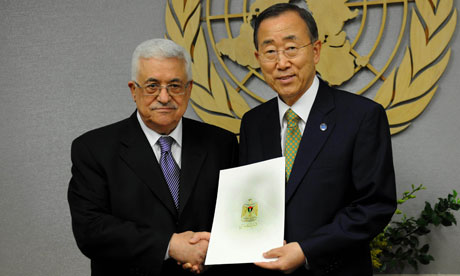
Mahmoud Abbas and Ban Ki-moon
Mahmoud Abbas submits a formal letter of application to Ban Ki-moon, asking for full Palestinian membership of the UN. Photograph: Shen Hong/Xinhua Press/Corbis
It was the United Nations that determined the fate of the Palestinian people more than six decades ago – and on Friday it was the UN that heard an impassioned plea to change the destiny of Palestine once more.
It came from Mahmoud Abbas, who was 12 years old when the UN General Assembly of November 1947 voted to partition Palestine into two states, one Jewish and one Arab. Abbas's predecessors, the Palestinian leaders of that earlier generation, famously rejected the partition plan – which envisaged a state on 44% of the land. So the Palestinian president came back to that same body on Friday, asking the UN to bless a Palestinian state on a terrain about half the size.
He did it with a flourish, holding up the formal letter of application he had submitted that hour to the UN secretary general, asking for full membership of the United Nations – a gesture that brought sustained applause from some delegates, impassive silence from others, including the United States and, inevitably, Israel. "It is a moment of truth and my people are waiting to hear the answer of the world," Abbas said, declaring: "After 63 years of suffering: enough, enough, enough."
The request for an answer was rhetorical. Abbas knew there was no chance of an immediate vote leading to recognition, not least because the US had promised its veto in advance and had leaned on several other allies to vote no.
But this was not about procedure or resolutions. This was about the Palestinians using the mechanics of diplomacy to grab a rare moment in the international sun, forcing the world to pay attention to their cause. Judged like that, it succeeded, as even the Quartet envoy Tony Blair – no enthusiast for the statehood move – had acknowledged before Abbas came to the podium.
Blair, like Barack Obama, has argued that the best outcome of the Palestinians' UN initiative will be a restart of direct peace talks, which – echoing the Israeli prime minister, Binyamin Netanyahu, who spoke less than an hour after Abbas – they insist are the only route to true Palestinian independence. But the Palestinian president offered little encouragement on that score.
For his was not the emollient address of a would-be peacemaker, packed with sweet sentiments about children living in harmony or hands reaching across the divide. Instead its emphasis was justice rather than peace, demanding redress for the wrongs inflicted on his people rather than searching for an accommodation with their neighbour.
The language was especially uncompromising, condemning the "colonial military occupation", "ethnic cleansing" and "the brutality of repression and racial discrimination". Abbas spoke of "apartheid" – always an incendiary word when applied to Israel-Palestine – and described what Israel calls its security barrier as a "racist annexation wall".
He gave much for Israeli hardliners to seize on, sentences they will say are evidence that Abbas is not serious about a genuine two state solution or even peace itself. Netanyahu later jumped on that reference to "63 years of suffering" as proof that the Palestinian grievance is not merely the post-1967 occupation, but the existence of Israel itself.
Abbas's defenders will say the president was simply referring to the long years the Palestinians have endured without statehood, but such is the way this perennial argument operates. Similarly, Abbas will not have made many new friends by describing the Holy Land as the birthplace of Christianity and Islam, but not Judaism. One of the Israelis' keenest demands is for their neighbours – adversaries – to acknowledge the ancient Jewish connection to the land, including the holy sites in Jerusalem. That sentence will be parsed and parsed again to suggest the Palestinians have not made the crucial leap of acceptance.
It means that while the Palestinian leader might have done himself some good with his own public and wider Arab opinion – defying his reputation as a bloodless technocrat, presenting himself as a fiery advocate – he will not have persuaded many of those whom he will ultimately need to shift, namely the men and women who make up Israeli public opinion.
Nor could those anxious for peace draw much encouragement from Netanyahu's address. True, he adopted the opposite of Abbas's approach, speaking of peace from the very start – opening with warm greetings for his Arab neighbours and insisting: "Israel wants peace, I want peace." But mainly he drew on his familiar catalogue of talking points – denouncing the UN as the "theatre of the absurd", a place where Gaddafi's Libya could head the human rights council; warning of the global threat of "militant Islam" and of Iran; stressing how Israel's every effort for peace, such as the 2005 withdrawal from Gaza, had only resulted in more war. That will have played well back home and worked wonders on Fox News, but will not have won many new friends.
So what the UN witnessed was no match for the historic session of 1947. Instead it saw two leaders talk at cross-purposes, offering two narratives that barely touch. Between them, they revealed to the world that they remain far apart – and that peace is as distant as ever.