Wikipedia Kuwait
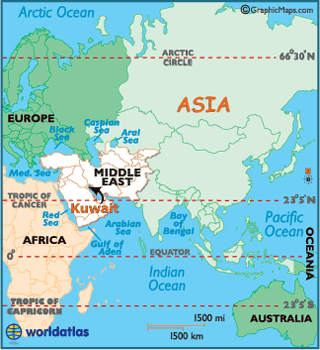
Kuwait is a small, oil-rich country nestling at the top of the Gulf (called the "Arabian Gulf" by Arabs and the "Persian Gulf" by Iran), flanked by large or powerful neighbors - Saudi Arabia to the south, Iraq to the north and Iran to the east.

 Flag was created in 1961 in the Pan-Arab colors. Black represents the defeat of the enemy, while red is the color of blood on the Kuwaiti swords. White symbolizes purity, and green is for the fertile land.
• Full name: The State of Kuwait
• Population: 2.8 million (UN, 2011)
• Capital: Kuwait
• Area: 17,818 sq km (6,880 sq miles)
• Major language: Arabic
• Major religion: Islam
• Currency: Kuwaiti Dinar (1 Dinar = 1000 fils) >> 1 Dinar = $3.52 so a 10 dinar note is about $35
• Life expectancy: 74 years (men), 76 years (women) (UN)
• Main exports: Oil
• GNI per capita: US $48,910 (World Bank, 2010)
• Internet domain: .kw
• International dialing code: +965
Kuwait’s oil fields were first exploited in the 1930s, and since the development of the petroleum industry after World War II and independence in 1961, oil has dominated the economy, making up around 90% of export revenues. In 1991, the country was the scene of a massive US-led international military campaign to oust Iraqi forces, which had invaded the year before. Operation Desert Storm saw their eventual removal, but Kuwait's infrastructure was left in bad shape and had to be rebuilt. Oil exports stopped for a time. Twelve years later, Kuwait played host to another massive military presence as thousands of soldiers massed on the Iraqi border for the US-led campaign in 2003 to disarm and oust the Iraqi leader Saddam Hussein. Kuwait was the first Arab country in the Gulf to have an elected parliament. Moves to change the male-dominated political structure culminated in the granting of full political rights to women in 2005. In May of that year, parliament gave women the right to vote and stand as candidates in elections for the 50-seat National Assembly. More generally, the growing assertiveness of parliament has led to frequent confrontations with the government, especially after Islamists made major gains at elections in February 2012. The annulment of those elections and subsequent changes to the election law prompted an opposition boycott of fresh polls in December 2012, putting Kuwait's relatively liberal political credentials in doubt. Despite large oil revenues, the economy has been badly affected by the global financial crisis. Economic policy-making has been held back by disputes between the ruling royal family and parliament.
Kuwait in the 80s
Kuwait: Class of 1990 (Al Jazeera) Fires of Kuwait (Saddam Invasion) Kuwaiti Right to Vote HISTORICAL TIMELINE
1600s - North-east portion of Arabian peninsula becomes part of the Ottoman Empire.
1700s - Settlers arrive at the site of present-day Kuwait City from the interior of the Arabian peninsula. The settlement grows into a bustling trading hub by the early
1800s. 1756 - Kuwait comes under the control of the Al-Sabah family, predecessors of Kuwait's present rulers. A degree of semi-autonomy from Ottoman Turkey prevails.
1899 - Fearing direct rule from Turkey, Sheikh Mubarak "the Great" strikes a deal with Britain and Kuwait becomes a protectorate. Britain provides naval protection in return for Kuwait allowing London to control its foreign affairs.
1937 - Large oil reserves discovered by the US-British Kuwait Oil Company. Exploitation is delayed by World War II, but thereafter fuels the country's development into a modern commercial center.
1951 - Major public-works program begins; Kuwait's infrastructure is transformed, residents enjoy a high standard of living.
Independence
1961 June - Kuwait becomes independent with the end of the British protectorate; the sheikh becomes an emir. The country joins the Arab League. Iraq renews claims that Kuwait is part of its territory but backs down after British military intervention.
1963 - Elections held for National Assembly, under terms of newly-drafted constitution.
1976 - Emir suspends National Assembly, saying it is not acting in the country's interests.
1980 - Iran-Iraq war: Kuwait supports Iraq strategically and financially.
1981 - National Assembly recalled; dissolved again in 1986.
1985-86 - Domestic security concerns, particularly about Iran's perceived influence over the Shi'ite minority, prompt the deportations of thousands of expatriates, many of them Iranian.
1990 July - Iraq complains to OPEC, accusing Kuwait of stealing its oil from a field near the border. Iraqi President Saddam Hussein threatens military action.
Iraqi Invasion
1990 August - Iraq invades and then annexes Kuwait. The emir and cabinet flee to Saudi Arabia.
 |
| Iraqi forces invaded Kuwait in 1990 and tried to retreat before a massive US-led coalition. Their abandoned vehicles are pictured outside Kuwait City. |
1991 March - Emir returns, imposes three-month period of martial law.
1992 - Under domestic and international pressure, Emir gives green light to National Assembly elections. Opposition forces perform well in the vote.
1993 - UN demarcates new Kuwait-Iraq border, awarding a port and a number of oil wells to Kuwait. US troops despatched to Kuwait following Iraqi border incursions.
1994 - Iraq officially recognises Kuwait's independence and the UN-demarcated borders following UN pressure and Russian mediation.
1999 - Emir suspends National Assembly after bitter feud between MPs and cabinet about misprints in state-published edition of the Koran. Government supporters suffer shock setback in resulting elections; liberals and Islamists predominate in the new assembly.
2001 March - Kuwaiti court commutes to life imprisonment a death sentence handed down in 2000 to the country's pro-Iraqi puppet ruler during the 1990-91 invasion.
Second Iraq War
2003 March - Tens of thousands of soldiers converge on the Kuwait-Iraq border for a US-led military campaign to disarm and oust Iraqi leader Saddam Hussein.
2003 July - Islamist and pro-government candidates fare well in parliamentary elections. There are major losses for liberal candidates. Emir appoints Sheikh Sabah al-Ahmad al-Sabah prime minister, separating post from role of heir to throne for first time since independence.
2005 January - Deadly gun battles erupt between suspected Islamist militants and police.
2005 May - Parliament approves a law allowing women to vote and run for parliament. In June the first woman cabinet minister, Massouma al-Mubarak, is appointed.
2006 January - The emir, Sheikh Jaber, dies. The crown prince, Sheikh Saad, succeeds him but is removed days later because of concerns about his ailing health. Sheikh Sabah al-Ahmad is sworn in as emir.
2006 February - Sheikh Sabah names his brother, Sheikh Nawaf, as crown prince and his nephew Sheikh Nasser as prime minister.
2006 April - Women cast their votes for the first time, in a municipal by-election.
2006 June - Women fail to win any seats in their first attempt to compete in parliamentary elections. The opposition - a loose alliance of reformists, liberals and Islamists - makes gains, winning nearly two-thirds of the seats.
2006 December - Information Minister Mohammad al-Sanousi resigns. He was to face questioning in parliament over allegations that he curbed media freedoms in the run-up to parliamentary elections in June.
Assertive parliament
2007 March - The government resigns in a move aimed at thwarting a no-confidence motion against the health minister. The new cabinet includes two women.
2007 June - Oil Minister Sheikh Ali resigns amid a political standoff between the government and parliament. 2007 July - Kuwaitis are urged to conserve electricity as generators struggle to meet demands of economic growth fuelled by record oil exports.
2008 March - Emir dissolves opposition-dominated parliament and calls elections for 17 May after cabinet quits over alleged lack of cooperation from MPs.
2008 May - Radical Islamists make gains in parliamentary elections, winning more than half of the 50 seats. No women are elected. Emir re-appoints Sheikh Nasser al-Mohammad al-Ahmad as prime minister.
2009 January - Prime Minister Sheikh Nasser Mohammad al-Ahmad al-Sabah forms new government after parliamentary row over visit by a Shia cleric.
2009 February - Foreign Minister Sheikh Muhammad al-Sabah flies to Baghdad in highest-level visit since Iraq's armed forces invaded Kuwait in 1990.
2009 March - Emir dissolves parliament after it demands to question his nephew and PM, Sheikh Nasser Mohammad al-Ahmad al-Sabah, about corruption allegations.
2009 May - Three women MPs - Kuwait's first - win seats in parliamentary elections.
2009 October - Constitutional court rules women can obtain passports without the consent of their husbands. In another ruling, it decides women MPs are not required to wear an Islamic head cover.
2009 December - Prime Minister survives an attempt by the opposition to remove him over corruption allegations.
2010 December - MPs injured as police clash with demonstrators protesting against alleged government plot to change constitution.
2011 March - Hundreds of young people demonstrate for reform, inspired by a wave of protests across the Arab world.
2011 December - Emir dissolves parliament and replaces his prime minister following protests and a showdown over allegations of high-level corruption.
2012 February - Islamist-led opposition wins majority in parliamentary elections.
2012 May - Emir blocks proposal by MPs to make all legislation comply with Islamic law.
2012 June - Constitutional Court ruling effectively dissolves Islamist-dominated parliament.
2012 September - Constitutional Court rejects government bill to redraw constituencies ahead of fresh elections. Opposition says the bill would have given official candidates an advantage.
2012 October - The Emir dissolves parliament, paving the way for snap elections. At least 5,000 protesters clash with security forces outside parliament over opposition fears that the government will try to redraw constituency boundaries.
2012 December - Elections boycotted by the opposition protesting against changes to electoral law.
Politics: After years of clashes between the elected parliament and the ruling family, the opposition boycotted elections in 2012; the country has faced violence from militant Islamists
Economy: Kuwait is one of the world's leading oil producers
International: Kuwait was invaded and occupied by Iraq in 1990; it served as a springboard for the US invasion of Iraq in 2003
LEADERSHIP
 |
| Sheikh Sabah has pursued a policy of cautious reform. |
 |
| Kuwait keeps alive the tradition of pearl diving, the basis of an important trade before the discovery of oil. |
Kuwait holds first place among Gulf states with regard to press freedom, Reporters Without Borders said in its 2010 report. But restraint is exercised when covering matters relating to the emir and senior royals. A press law forbids references to God and the Prophet that are deemed insulting. Criticism of the emir, the constitution, the judiciary and the "basic convictions of the nation" is prohibited. Courts can prescribe prison sentences for defamation and "attacks" on religion. State-owned TV and radio operate alongside private broadcasters. Pan-Arab satellite stations are widely watched. Newspaper publishers must have licences from the Ministry of Information. The ministry censors books, films, periodicals and other imported publications deemed morally offensive. BBC World Service is available on FM in Kuwait City (in Arabic on 90.1, English on 100.1). Kuwait had 1.1 million internet users by June 2010 (InternetWorldStats). A pervasive filtering system blocks content deemed immoral or politically-sensitive. Internet cafe owners must obtain the names, ID numbers of customers. Officials have signalled plans to regulate social networks in order to safeguard social "cohesion". Twitter users have fallen foul of the law over posts deemed to be insulting or blasphemous.
The press
Al-Watan - private, daily
Al-Qabas - private, daily
Al-Rai al-Amm - private, daily
Kuwait Times - English-language
Arab Times - English-language
Television
Kuwaiti TV - state-run,
operates four networks and satellite channel
Al-Rai - first private TV,
via satellite
Al-Sabah - private
Al-Watan - private
Al-Resalah - private,
religious
Radio
Radio Kuwait - state-run,
programmes in English and Arabic
Marina FM - first private
radio station, music-based
News agency
Kuwait News Agency (Kuna) - in Arabic and
English
Reporters Without Borders
1 journalists
imprisoned (6 month prison sentence for newspaper editor)
Kuwait boasts a score of privately owned daily and weekly
newspapers in Arabic and two English-language dailies. Kuwait’s written press
has for decades played a major role in the political debate and reflects a
tradition of diversity and outspokenness. It gives wide coverage to political
debates during election campaigns.
Freedom of expression has been given a further boost by the
liberalisation of the broadcast sector and the creation of numerous satellite
television channels as a result of several press law reforms. Parliament has,
since the beginning of 2009, been debating the possibility of setting up a
24-hour news channel similar to al-Jazeera and al-Arabiyya. The
launch of such a channel is seen as a means of furthering the state’s
influence.
Kuwaiti legislation has become the most liberal in the region,
since press law reform in 2006 that abolished the use of prison sentences.
Moreover, a newspaper can only be closed down on the order of a court.
However, criminal law – that does provide for prison sentences –
still applies to some offences, such as “defamation” or “attacks on religion”.
And even if the threat of prison no longer hangs over journalists like a sword
of Damocles as it did before 2006, heavy fines recently handed down by some
judges have undermined some of the advances made by the local and foreign
press. The Kuwait Journalists’ Association has recorded more than 90 defamation
cases currently under judgement.
There are effectively some “red lines” that the emirate’s journalists
cannot cross. The person of the head of state and members of the royal family
or people holding key posts all remain sensitive subjects that are not raised.
The level of self-censorship among Kuwaiti journalists is still quite high.
Kuwait’s information ministry on 25 August 2009 blacked out the
broadcasting of the satirical programme Sawtak Wasal on privately owned
satellite channel Scope TV, after it had put out three episodes
lampooning Kuwaiti political figures. More about Kuwaiti censorship here.
Kuwait Shuts Down Al Jazeera for “Meddling” (Dec 2012)
Kuwait to Re-open Al Jazeera (Dec 2012)
Kuwait City
Kuwait in Crisis – Al Jazeera English (Dec 2012)
A political crisis brews after opposition groups promise to bring down controversial new parliament.
A political crisis brews after opposition groups promise to bring down controversial new parliament.

 Kuwait University

More Political, Economic, Historical and Demographic date here:
Index Mundi Kuwait
CIA World Factbook Kuwait
UN Country Profile Kuwait
State Dept. Human Rights Country Report 2011

