| Opinion | ||||
| The humiliation of Barack Obama | ||||
As he prepares to singularly veto Palestine's statehood bid, he must be thinking to himself: 'This isn't right'.
| ||||
Sooner or later, it's going to happen. Most likely, the moment will come just before his
first head-of-state meeting in New York. Or perhaps it will happen just before his first
side-bar meeting with Binyamin Netanyahu. Or then again, it may come as the cumulative
reaction to a series of embarrassing encounters with fellow world leaders.
But the moment will come.
At some point this coming week, during his visit to the this year's opening of the United
Nations General Assembly in New York, US President Barack Obama is going to have
a nearly irresistible urge. He is going to want to stand up to his hovering political handlers
and the smothering bureaucracy which tries to dictate his every move, summon his
personal dignity, and say "Enough".
In April of 1995, President Clinton played host to then-Prime Minister Benazir Bhutto of
Pakistan. US-Pakistan relations were in sharp decline. A few years before, the US had
begun to implement sanctions mandated by the so-called Pressler Amendment, under
which Pakistan was to be punished with a complete cutoff of aid and of military sales if
it were found to be pursuing a nuclear-weapons capability. The first President Bush had
made such a finding, and now the ties between the two countries were being progressively
cut. At the heart of the growing ill-feeling between the two nations was the US cancellation
of a previously-agreed sale of 28 F-16 fighter aircraft. The Pakistanis had realized when
they signed the purchase deal that it might be cancelled if the Pressler Amendment were
invoked. Now, given the law and the previous assertion of Pakistani culpability from
President Bush, there was no longer any question of delivering the aircraft. But there was
another wrinkle.
The Pakistanis had paid enormous sums of money which they could ill afford, in advance,
for the airplanes. And now, according to the US, not only could the Pakistanis not have
the warplanes, but they couldn't have their money back, either. You see, the money wasn't
there anymore; it had been spent by the contractor. The planes had been built. There was
no provision under US law to provide appropriated funds to compensate the Pakistanis.
Yes, the F-16s could perhaps be sold to another country and the proceeds given to
Pakistan, but that, too, might require approval from a hostile US congress, and would
most likely not be forthcoming. In short, there was nothing to be done. And as if to add
insult to injury, the Pakistanis were also being charged a hefty annual storage fee for
each plane - each plane that they could not have.
Defending the indefensible
When the entire US foreign policy/national security apparatus begins to move in one
direction, it is an impressive sight. A vast bureaucracy churns out elaborate rationales
for its decided policy, and these are mind-numbingly repeated in dozens of different ways
for use in dozens of different fora. This was a classic case in point.
I saw it myself from inside the State Department bureaucracy, where I was serving at the time.
Justifications for the patently unjustifiable were delivered to the Pakistanis at all levels. They
were mouthed by State Department and White House spokesmen, repeated in Congressional
testimony, delivered to the press in many different settings, elaborated in written responses to
inquiries from congressmen and the public, to say nothing of internal communications in the
Executive Branch.

All of this bureaucratic momentum hurtled forward towards
the climactic moment when President Clinton would deliver
the same message, in person, to Prime Minister Bhutto.
The preparations for such encounters are, again, highly
impressive. Huge briefing books requiring hundreds of
man-hours are drawn up. They contain scene-setters,
and backgrounders, and elaborate policy justifications,
backed up with legal briefs organised under
alphabeticized tabs, followed by detailed talking points
himself at the UN, as he tries to dummy. And then the whole lot is coordinated and explain why he must singularly veto cleared up through the system through the secretary of state, the bid for Palestinian statehood and the National Security Council, to the president himself. And so it was here. But in this case, at the very end, having carefully studied all this codified nonsense, this monument to bureaucratic inertia, and just before walking in to meet with Bhutto, when he would have to look the Pakistani prime minister in the eye and defend the patently indefensible, Clinton did something no one - but no
one - in the bureaucracy would ever have anticipated.
With simple, clear-eyed common sense and the innate sense of justice with which God has
endowed most five-year-old children, he said, simply, "but this is not fair". And then,
wonder of wonders, he walked in and said just that to Bhutto.
Here are Clinton's words recorded moments later, when the two leaders emerged to speak
before the press: "I have already made it clear to you, and I don't think any American
president has ever said this before, I don't think it's right for us to keep the money and
the equipment. That is not right. And I am going to try to find a resolution to it." If you have
not served in America's foreign policy bureaucracy, if you have not seen this from the inside,
you cannot imagine the effect which these words would have had - to have a fully elaborated
policy position publicly repudiated by the president, completely and unexpectedly, at the
last possible moment, and on a world stage. It must have been wonderful. Alas, having seen
all the preparation, I was not there for the denouement, having moved on to another job. I
would have given anything to see it.
Could it happen again?
But this was a comparatively minor issue, followed by few people outside South Asian policy
circles. So just imagine, if you can, something analogous happening at the UN this week,
when President Obama has to justify current US policy regarding the Palestinian bid for
international recognition as a state.
We all know what the Americans have been saying: That what President Mahmoud Abbas
(Abu Mazen) is doing is counter-productive, that it is a repudiation of the Oslo Accords, that
it is an attempt to avoid the necessity of reaching a negotiated solution with the Israelis. We
have seen the US policy juggernaut gearing up, as the same arguments are repeated by US
envoys to the Palestinians and to the Quartet, elaborated publicly by the secretary of
state and by the White House spokesman, and delivered in dozens of other fora, both
great and small.
However, repeating the same thing, loudly and insistently, does not make it so. President
Obama knows this very well. He understands the Israeli-Palestinian issue backwards and
forwards. He knows the peace process is at a dead end.
Early in his administration, he tried to revive negotiations by mandating a complete West
Bank settlement freeze, only to be forced embarrassingly by Israeli Prime Minister
Netanyahu to back down. When this past May he had the temerity to publicly tell the
Israelis that their current policy towards the Palestinians is untenable and unsustainable,
and to modestly suggest a negotiating formula to break the impasse, he was publicly
chastised by Netanyahu and had to submit to the humiliation of seeing the Congressional
leaders of his own party repudiate him in favour of the Israeli prime minister.
In response, though he cannot admit it, Obama has washed his hands of the Palestinian
issue. He knows he can do nothing more. And yet, the issue will not go away.
Now, once again, he is being forced to publicly support an Israeli policy position
fundamentally opposed to his own. He knows fully well that Netanyahu has no intention
of permitting formation of a viable Palestinian state, and that the Palestinians have little
choice but to pursue their current course at the UN.
He likewise understands that the US' lonely support for Israel and the inevitable US veto
of the Palestinians' bid for full UN membership will undermine, perhaps terminally, the
US position in a democratising Middle East, and will expose the US' nominal support
for popular Arab rights as a fraud.
The human dimension
All of this is well understood. We can all see it coming. And yet what is often forgotten
is the human dimension.
It is one thing to have to sacrifice principle in the face of political reality. All politicians
are forced to do so at various points. But it is another to do so in a highly public manner,
to have to mouth patent falsehoods in one-on-one meetings with fellow world leaders, who
know better and who will think less of you as a result.For the leader of a great nation, at
certain points the public becomes personal, as it did for Bill Clinton one day in April, 1995.
I do not know President Obama personally, but my sense is that this is a proud man. He
does not see himself as an ordinary politician, but as a transformative leader. He has
attempted self-consciously to carve out such a role for himself in the context of US
relations with the Muslim world, but he has been repeatedly stymied, publicly and
disgracefully.
This is what lies in store for President Obama in New York, and he knows it.
For one as busy as a US president, there are many distractions, many ways to avoid
confronting the unpleasant. But at some point, when the president is alone with his briefing
book in New York, it is going to strike him. He will feel a tightening in his chest, and he will
have an urge to pick up this plastic-bound tome to craven political expediency and hurl it at
someone, and then to walk out and say what he really thinks.
We all know that the president will do no such thing. He will suppress this urge, for to do
otherwise would spell political suicide. No, the president will swallow his anger, and do what
he must do. But it is worth giving some consideration, as the US again undermines its
security and its global position, pointlessly and gratuitously, in blind allegiance to an
ungrateful and self-destructive ally, that we will also be watching something else,
something far more personal: The public mortification of Barack Hussein Obama.
Robert Grenier is a retired, 27-year veteran of the CIA's Clandestine Service.
He was Director of the CIA's Counter-Terrorism Center from 2004 to 2006.
The views expressed in this article are the author's own and do not necessarily
reflect Al Jazeera's editorial policy.
|


Saudi king allows women to vote in local elections
 By ABDULLAH AL-SHIHRI and MAAMOUN YOUSSEF - AP – Sep 25, 2011
RELATED CONTENT
- FILE - In this Thursday, April 1, 2010 file photo, Saudi women attend the traditional …
- FILE - In this Nov. 11, 2010 file photo, Saudi woman with cellphones smoke tobacco …


WORLD SLIDESHOWS
Palestinians rally to support U.N. membership bid
34 photos - Fri, Sep 23, 2011India's stray dogs
7 photos - Fri, Sep 23, 2011World Car Free Day
23 photos - Thu, Sep 22, 2011


RIYADH, Saudi Arabia (AP) — Saudi King Abdullah announced Sunday that the nation's women will gain the right to vote and run as candidates in local elections to be held in 2015 in a major advancement for the rights of women in the deeply conservative Muslim kingdom.
In an annual speech before his advisory assembly, or Shura Council, the Saudi monarch said he ordered the step after consulting with the nation's top religious clerics, whose advice carries great weight in the kingdom.
"We refuse to marginalize the role of women in Saudi society and in every aspect, within the rules of Sharia," Abdullah said, referring to the Islamic law that governs many aspects of life in the kingdom.
The right to vote is by far the biggest change introduced by Abdullah, considered a reformer, since he became the country's de facto ruler in 1995 during the illness of King Fahd. Abdullah formally ascended to the throne upon Fahd's death in August 2005.
The kingdom's great oil wealth and generous handouts to citizens have largely insulated it from the unrest sweeping the Arab world. But the king has taken steps to quiet rumblings of discontent that largely centered on the eastern oil-producing region populated by the country's Shiite Muslim minority.
Mindful of the unrest, which reached Saudi Arabia's doorstep with street protests and a deadly crackdown in neighboring Bahrain, King Abdullah pledged roughly $93 billion in financial support to boost jobs and services for Saudis in March.
Seizing on the season of protest in the Arab world, Saudi women's groups have also staged public defiance of the kingdom's ban on female driving. Saudi authorities went relatively easy on the women, who took to the roads earlier this year and gained worldwide attention through social media.
Abdullah said the changes announced Sunday would also allow women to be appointed to the Shura Council, the advisory body selected by the king that is currently all-male.
The council, established in 1993, offers opinions on general policies in the kingdom and debates economic and social development plans and agreements signed between the kingdom and other nations.
Saudi Arabia, the birthplace of Islam, follows deeply conservative social traditions and adheres closely to a strict version of Islam. Despite Abdullah's attempts to push through some social reforms, women still cannot drive and the sexes are segregated in public.
Saudi Arabia held its first-ever municipal elections in 2005.
The kingdom will hold its next municipal elections on Thursday, but women will not be able to vote or run in those contests.
In announcing the reforms, Abdullah sought to ground his decision in religion.
"Muslim women in our Islamic history have demonstrated positions that expressed correct opinions and advice," he said, citing examples from the era of Islam's Prophet Muhammad in the seventh century.
He said the members of Saudi Arabia's clerical council, or Ulema, praised and supported his decision.
He also acknowledged the yearning for greater social freedoms in the kingdom.
"Balanced modernization, which falls within our Islamic values, is an important demand in an era where there is no place for defeatist or hesitant people," he said.
In January, a group of female activists launched a campaign on social networking websites to push the kingdom to allow women to vote and run in the municipal elections.
___
Youssef reported from Cairo.
Palestine: 'After 63 years' suffering – enough, enough,' says Abbas
Jonathan Freedland on the impassioned plea for the UN to give its blessing to the creation of a Palestinian state

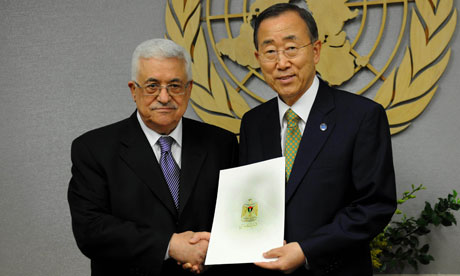
Mahmoud Abbas submits a formal letter of application to Ban Ki-moon, asking for full Palestinian membership of the UN. Photograph: Shen Hong/Xinhua Press/Corbis
It was the United Nations that determined the fate of the Palestinian people more than six decades ago – and on Friday it was the UN that heard an impassioned plea to change the destiny of Palestine once more.
It came from Mahmoud Abbas, who was 12 years old when the UN General Assembly of November 1947 voted to partition Palestine into two states, one Jewish and one Arab. Abbas's predecessors, the Palestinian leaders of that earlier generation, famously rejected the partition plan – which envisaged a state on 44% of the land. So the Palestinian president came back to that same body on Friday, asking the UN to bless a Palestinian state on a terrain about half the size.
He did it with a flourish, holding up the formal letter of application he had submitted that hour to the UN secretary general, asking for full membership of the United Nations – a gesture that brought sustained applause from some delegates, impassive silence from others, including the United States and, inevitably, Israel. "It is a moment of truth and my people are waiting to hear the answer of the world," Abbas said, declaring: "After 63 years of suffering: enough, enough, enough."
The request for an answer was rhetorical. Abbas knew there was no chance of an immediate vote leading to recognition, not least because the US had promised its veto in advance and had leaned on several other allies to vote no.
But this was not about procedure or resolutions. This was about the Palestinians using the mechanics of diplomacy to grab a rare moment in the international sun, forcing the world to pay attention to their cause. Judged like that, it succeeded, as even the Quartet envoy Tony Blair – no enthusiast for the statehood move – had acknowledged before Abbas came to the podium.
Blair, like Barack Obama, has argued that the best outcome of the Palestinians' UN initiative will be a restart of direct peace talks, which – echoing the Israeli prime minister, Binyamin Netanyahu, who spoke less than an hour after Abbas – they insist are the only route to true Palestinian independence. But the Palestinian president offered little encouragement on that score.
For his was not the emollient address of a would-be peacemaker, packed with sweet sentiments about children living in harmony or hands reaching across the divide. Instead its emphasis was justice rather than peace, demanding redress for the wrongs inflicted on his people rather than searching for an accommodation with their neighbour.
The language was especially uncompromising, condemning the "colonial military occupation", "ethnic cleansing" and "the brutality of repression and racial discrimination". Abbas spoke of "apartheid" – always an incendiary word when applied to Israel-Palestine – and described what Israel calls its security barrier as a "racist annexation wall".
He gave much for Israeli hardliners to seize on, sentences they will say are evidence that Abbas is not serious about a genuine two state solution or even peace itself. Netanyahu later jumped on that reference to "63 years of suffering" as proof that the Palestinian grievance is not merely the post-1967 occupation, but the existence of Israel itself.
Abbas's defenders will say the president was simply referring to the long years the Palestinians have endured without statehood, but such is the way this perennial argument operates. Similarly, Abbas will not have made many new friends by describing the Holy Land as the birthplace of Christianity and Islam, but not Judaism. One of the Israelis' keenest demands is for their neighbours – adversaries – to acknowledge the ancient Jewish connection to the land, including the holy sites in Jerusalem. That sentence will be parsed and parsed again to suggest the Palestinians have not made the crucial leap of acceptance.
It means that while the Palestinian leader might have done himself some good with his own public and wider Arab opinion – defying his reputation as a bloodless technocrat, presenting himself as a fiery advocate – he will not have persuaded many of those whom he will ultimately need to shift, namely the men and women who make up Israeli public opinion.
Nor could those anxious for peace draw much encouragement from Netanyahu's address. True, he adopted the opposite of Abbas's approach, speaking of peace from the very start – opening with warm greetings for his Arab neighbours and insisting: "Israel wants peace, I want peace." But mainly he drew on his familiar catalogue of talking points – denouncing the UN as the "theatre of the absurd", a place where Gaddafi's Libya could head the human rights council; warning of the global threat of "militant Islam" and of Iran; stressing how Israel's every effort for peace, such as the 2005 withdrawal from Gaza, had only resulted in more war. That will have played well back home and worked wonders on Fox News, but will not have won many new friends.
So what the UN witnessed was no match for the historic session of 1947. Instead it saw two leaders talk at cross-purposes, offering two narratives that barely touch. Between them, they revealed to the world that they remain far apart – and that peace is as distant as ever.
Beyond Cairo, Israel Sensing a Wider Siege

Amel Pain/European Pressphoto Agency
Egyptian security forces surrounded a youth accused
of taking part in an attempt to storm the Israeli embassy.
of taking part in an attempt to storm the Israeli embassy.
By ETHAN BRONNER
Published: September 10, 2011

JERUSALEM — With its Cairo embassy ransacked, its ambassador to Turkey expelled and the Palestinians seeking statehood recognition at the United Nations, Israel found itself on Saturday increasingly isolated and grappling with a radically transformed Middle East where it believes its options are limited and poor.
Related
After Attack on Embassy, Egypt Vows a Tougher Stance on Protests (September 11, 2011)
Times Topic: Israel
The diplomatic crisis, in which winds unleashed by the Arab Spring are now casting a chill over the region, was crystallized by the scene of Israeli military jets sweeping into Cairo at dawn on Saturday to evacuate diplomats after the Israeli Embassy had been besieged by thousands of protesters.
It was an image that reminded some Israelis of Iran in 1979, when Israel evacuated its embassy in Tehran after the revolution there replaced an ally with an implacable foe.
“Seven months after the downfall of Hosni Mubarak’s regime, Egyptian protesters tore to shreds the Israeli flag, a symbol of peace between Egypt and its eastern neighbor, after 31 years,” Aluf Benn, the editor in chief of the left-leaning Israeli newspaper Haaretz, wrote Saturday. “It seems that the flag will not return to the flagstaff anytime soon.”
Egypt and Israel both issued statements on Saturday reaffirming their commitments to their peace treaty, but in a televised address on Saturday night, Prime Minister Benjamin Netanyahu of Israel warned that Egypt “cannot ignore the heavy damage done to the fabric of peace.”
Facing crises in relations with Egypt and Turkey, its two most important regional allies, Israel turned to the United States. Throughout the night on Friday, desperate Israeli officials called their American counterparts seeking help to pressure the Egyptians to protect the embassy.
President Obama “expressed his great concern” in a telephone call with Mr. Netanyahu, the White House said in a statement, and he called on Egypt “to honor its international obligations to safeguard the security of the Israeli Embassy.”
Washington — for whom Israel, Turkey and Egypt are all critical allies — has watched tensions along the eastern Mediterranean with growing unease and increasing alarm. And though the diplomatic breaches were not entirely unexpected, they prompted a flurry of diplomatic activity in Washington.
The mayhem in Cairo also exacted consequences for Egypt, raising questions about whether its military-led transitional government would be able to maintain law and order and meet its international obligations. The failure to prevent an invasion of a foreign embassy raised security concerns at other embassies as well.
The Egyptian government responded to those questions Saturday night, pledging a new crackdown on disruptive protests and reactivating the emergency law allowing indefinite detentions without trial, one of the most reviled measures enacted under former President Hosni Mubarak.
Since the start of the Arab uprisings, internal critics and foreign friends, including the United States, have urged Israel to take bold conciliatory steps toward the Palestinians, and after confrontations in which Israeli forces killed Egyptian and Turkish citizens, to reach accommodations with both countries.
Turkey expelled the Israeli ambassador a week ago over Israel’s refusal to apologize for a deadly raid last year on a Turkish ship bound for Gaza in which nine Turks were killed. The storming of the embassy in Cairo on Saturday was precipitated by the killing of three Egyptian soldiers along the border by Israeli military forces pursuing terrorism suspects.
Israel has expressed regret for the deaths in both cases, but has not apologized for actions that it considers defensive.
The overriding assessment of the government of Mr. Netanyahu is that such steps will only make matters worse because what is shaking the region is not about Israel, even if Israel is increasingly its target, and Israel can do almost nothing to affect it.
“Egypt is not going toward democracy but toward Islamicization,” said Eli Shaked, a former Israeli ambassador to Cairo who reflected the government’s view. “It is the same in Turkey and in Gaza. It is just like what happened in Iran in 1979.”
A senior official said Israel had few options other than to pursue what he called a “porcupine policy” to defend itself against aggression. Another official, asked about Turkey, said, “There is little that we can do.”
Critics of the government take a very different view.
Mr. Benn, the Haaretz editor, acknowledged that Mr. Netanyahu could not be faulted for the events in Egypt, the rise of an Islamic-inspired party in Turkey or Iran’s nuclear program. But echoing criticism by the Obama administration, he said that Mr. Netanyahu “has not done a thing to mitigate the fallout from the aforementioned developments.”
Daniel Ben-Simon, a member of Parliament from the left-leaning Labor Party, said the Netanyahu government was on a path “not just to diplomatic isolation but to actually putting Israelis in danger,” he said. “It all comes down to his obsession against a Palestinian state, his total paralysis toward the Palestinian issue. We are facing an international tide at the United Nations. If he joined the vote for a Palestinian state instead of fighting it, that would be the best thing he could do for us in the Arab world.”
Related
After Attack on Embassy, Egypt Vows a Tougher Stance on Protests (September 11, 2011)
Times Topic: Israel
The Palestinians have given up on talks with Israel, and within the next two weeks they plan to ask the United Nations to grant them membership and statehood recognition within the 1967 lines, including East Jerusalem as a capital.
Potential side effects of the diplomatic disputes have already emerged.
The growing hostility from Egypt could require a radical rethinking of Israel’s defense doctrine which, for the past three decades, counted on peace on its southern border. As chaos in the Sinai has increased and anti-Israel sentiment in Egypt has grown, military strategists here are examining how to beef up protection of the south, including by the building of an anti-infiltration wall in the Sinai.
A threat by Turkey last week to challenge Israel’s plans for gas exploration in the eastern Mediterranean could threaten Israel’s agreement with Cyprus on gas drilling and could worsen tensions with Lebanon on drilling rights.
Initial Israeli fears about the Arab Spring uprisings have begun to materialize in concrete ways. When the uprisings began in Tunisia and Egypt at the start of the year, little attention was directed toward Israel because so much focus was on throwing off dictatorial rule and creating a new political order.
Traditionally, many Arab leaders have used Israel as a convenient scapegoat, turning public wrath against it and blaming it for their problems. The faint hope here was that a freer Middle East might move away from such anti-Israel hostility because the overthrow of dictators would open up debate.
But as the months of Arab Spring have turned autumnal, Israel has increasingly become a target of public outrage. Some here say Israel is again being made a scapegoat, this time for unfulfilled revolutionary promises.
But there is another interpretation, and it is the predominant one abroad — Muslims, Arabs and indeed many around the globe believe Israel is unjustly occupying Palestinian territories, and they are furious at Israel for it. And although some Israelis pointed fingers at Islamicization as the cause of the violence, Egyptians noted Saturday that Islamist groups, including the Muslim Brotherhood, distanced themselves from Friday’s protests and did not attend, while legions of secular-minded soccer fans were at the forefront of the embassy attacks.
“The world is tired of this conflict and angry at us because we are viewed as conquerors, ruling over another people,” said Binyamin Ben-Eliezer, a Labor Party member of Parliament and a former defense minister. “If I were Bibi Netanyahu, I would recognize a Palestinian state. We would then negotiate borders and security. Instead nothing is happening. We are left with one ally, America, and that relationship is strained, too.”
Subscribe to:
Posts (Atom)