Understanding the American Right


Palestine: 'After 63 years' suffering – enough, enough,' says Abbas

Jonathan Freedland on the impassioned plea for the UN to give its blessing to the creation of a Palestinian state

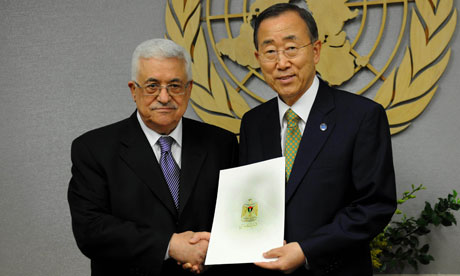
Mahmoud Abbas and Ban Ki-moon
Mahmoud Abbas submits a formal letter of application to Ban Ki-moon, asking for full Palestinian membership of the UN. Photograph: Shen Hong/Xinhua Press/Corbis
It was the United Nations that determined the fate of the Palestinian people more than six decades ago – and on Friday it was the UN that heard an impassioned plea to change the destiny of Palestine once more.
It came from Mahmoud Abbas, who was 12 years old when the UN General Assembly of November 1947 voted to partition Palestine into two states, one Jewish and one Arab. Abbas's predecessors, the Palestinian leaders of that earlier generation, famously rejected the partition plan – which envisaged a state on 44% of the land. So the Palestinian president came back to that same body on Friday, asking the UN to bless a Palestinian state on a terrain about half the size.
He did it with a flourish, holding up the formal letter of application he had submitted that hour to the UN secretary general, asking for full membership of the United Nations – a gesture that brought sustained applause from some delegates, impassive silence from others, including the United States and, inevitably, Israel. "It is a moment of truth and my people are waiting to hear the answer of the world," Abbas said, declaring: "After 63 years of suffering: enough, enough, enough."
The request for an answer was rhetorical. Abbas knew there was no chance of an immediate vote leading to recognition, not least because the US had promised its veto in advance and had leaned on several other allies to vote no.
But this was not about procedure or resolutions. This was about the Palestinians using the mechanics of diplomacy to grab a rare moment in the international sun, forcing the world to pay attention to their cause. Judged like that, it succeeded, as even the Quartet envoy Tony Blair – no enthusiast for the statehood move – had acknowledged before Abbas came to the podium.
Blair, like Barack Obama, has argued that the best outcome of the Palestinians' UN initiative will be a restart of direct peace talks, which – echoing the Israeli prime minister, Binyamin Netanyahu, who spoke less than an hour after Abbas – they insist are the only route to true Palestinian independence. But the Palestinian president offered little encouragement on that score.
For his was not the emollient address of a would-be peacemaker, packed with sweet sentiments about children living in harmony or hands reaching across the divide. Instead its emphasis was justice rather than peace, demanding redress for the wrongs inflicted on his people rather than searching for an accommodation with their neighbour.
The language was especially uncompromising, condemning the "colonial military occupation", "ethnic cleansing" and "the brutality of repression and racial discrimination". Abbas spoke of "apartheid" – always an incendiary word when applied to Israel-Palestine – and described what Israel calls its security barrier as a "racist annexation wall".
He gave much for Israeli hardliners to seize on, sentences they will say are evidence that Abbas is not serious about a genuine two state solution or even peace itself. Netanyahu later jumped on that reference to "63 years of suffering" as proof that the Palestinian grievance is not merely the post-1967 occupation, but the existence of Israel itself.
Abbas's defenders will say the president was simply referring to the long years the Palestinians have endured without statehood, but such is the way this perennial argument operates. Similarly, Abbas will not have made many new friends by describing the Holy Land as the birthplace of Christianity and Islam, but not Judaism. One of the Israelis' keenest demands is for their neighbours – adversaries – to acknowledge the ancient Jewish connection to the land, including the holy sites in Jerusalem. That sentence will be parsed and parsed again to suggest the Palestinians have not made the crucial leap of acceptance.
It means that while the Palestinian leader might have done himself some good with his own public and wider Arab opinion – defying his reputation as a bloodless technocrat, presenting himself as a fiery advocate – he will not have persuaded many of those whom he will ultimately need to shift, namely the men and women who make up Israeli public opinion.
Nor could those anxious for peace draw much encouragement from Netanyahu's address. True, he adopted the opposite of Abbas's approach, speaking of peace from the very start – opening with warm greetings for his Arab neighbours and insisting: "Israel wants peace, I want peace." But mainly he drew on his familiar catalogue of talking points – denouncing the UN as the "theatre of the absurd", a place where Gaddafi's Libya could head the human rights council; warning of the global threat of "militant Islam" and of Iran; stressing how Israel's every effort for peace, such as the 2005 withdrawal from Gaza, had only resulted in more war. That will have played well back home and worked wonders on Fox News, but will not have won many new friends.
So what the UN witnessed was no match for the historic session of 1947. Instead it saw two leaders talk at cross-purposes, offering two narratives that barely touch. Between them, they revealed to the world that they remain far apart – and that peace is as distant as ever.

Beyond Cairo, Israel Sensing a Wider Siege


Amel Pain/European Pressphoto Agency
Egyptian security forces surrounded a youth accused
of taking part in an attempt to storm the Israeli embassy.


JERUSALEM — With its Cairo embassy ransacked, its ambassador to Turkey expelled and the Palestinians seeking statehood recognition at the United Nations, Israel found itself on Saturday increasingly isolated and grappling with a radically transformed Middle East where it believes its options are limited and poor.
The diplomatic crisis, in which winds unleashed by the Arab Spring are now casting a chill over the region, was crystallized by the scene of Israeli military jets sweeping into Cairo at dawn on Saturday to evacuate diplomats after the Israeli Embassy had been besieged by thousands of protesters.
It was an image that reminded some Israelis of Iran in 1979, when Israel evacuated its embassy in Tehran after the revolution there replaced an ally with an implacable foe.
“Seven months after the downfall of Hosni Mubarak’s regime, Egyptian protesters tore to shreds the Israeli flag, a symbol of peace between Egypt and its eastern neighbor, after 31 years,” Aluf Benn, the editor in chief of the left-leaning Israeli newspaper Haaretz, wrote Saturday. “It seems that the flag will not return to the flagstaff anytime soon.”
Egypt and Israel both issued statements on Saturday reaffirming their commitments to their peace treaty, but in a televised address on Saturday night, Prime Minister Benjamin Netanyahu of Israel warned that Egypt “cannot ignore the heavy damage done to the fabric of peace.”
Facing crises in relations with Egypt and Turkey, its two most important regional allies, Israel turned to the United States. Throughout the night on Friday, desperate Israeli officials called their American counterparts seeking help to pressure the Egyptians to protect the embassy.
President Obama “expressed his great concern” in a telephone call with Mr. Netanyahu, the White House said in a statement, and he called on Egypt “to honor its international obligations to safeguard the security of the Israeli Embassy.”
Washington — for whom Israel, Turkey and Egypt are all critical allies — has watched tensions along the eastern Mediterranean with growing unease and increasing alarm. And though the diplomatic breaches were not entirely unexpected, they prompted a flurry of diplomatic activity in Washington.
The mayhem in Cairo also exacted consequences for Egypt, raising questions about whether its military-led transitional government would be able to maintain law and order and meet its international obligations. The failure to prevent an invasion of a foreign embassy raised security concerns at other embassies as well.
The Egyptian government responded to those questions Saturday night, pledging a new crackdown on disruptive protests and reactivating the emergency law allowing indefinite detentions without trial, one of the most reviled measures enacted under former President Hosni Mubarak.
Since the start of the Arab uprisings, internal critics and foreign friends, including the United States, have urged Israel to take bold conciliatory steps toward the Palestinians, and after confrontations in which Israeli forces killed Egyptian and Turkish citizens, to reach accommodations with both countries.
Turkey expelled the Israeli ambassador a week ago over Israel’s refusal to apologize for a deadly raid last year on a Turkish ship bound for Gaza in which nine Turks were killed. The storming of the embassy in Cairo on Saturday was precipitated by the killing of three Egyptian soldiers along the border by Israeli military forces pursuing terrorism suspects.
Israel has expressed regret for the deaths in both cases, but has not apologized for actions that it considers defensive.
The overriding assessment of the government of Mr. Netanyahu is that such steps will only make matters worse because what is shaking the region is not about Israel, even if Israel is increasingly its target, and Israel can do almost nothing to affect it.
“Egypt is not going toward democracy but toward Islamicization,” said Eli Shaked, a former Israeli ambassador to Cairo who reflected the government’s view. “It is the same in Turkey and in Gaza. It is just like what happened in Iran in 1979.”
A senior official said Israel had few options other than to pursue what he called a “porcupine policy” to defend itself against aggression. Another official, asked about Turkey, said, “There is little that we can do.”
Critics of the government take a very different view.
Mr. Benn, the Haaretz editor, acknowledged that Mr. Netanyahu could not be faulted for the events in Egypt, the rise of an Islamic-inspired party in Turkey or Iran’s nuclear program. But echoing criticism by the Obama administration, he said that Mr. Netanyahu “has not done a thing to mitigate the fallout from the aforementioned developments.”


Daniel Ben-Simon, a member of Parliament from the left-leaning Labor Party, said the Netanyahu government was on a path “not just to diplomatic isolation but to actually putting Israelis in danger,” he said. “It all comes down to his obsession against a Palestinian state, his total paralysis toward the Palestinian issue. We are facing an international tide at the United Nations. If he joined the vote for a Palestinian state instead of fighting it, that would be the best thing he could do for us in the Arab world.”
The Palestinians have given up on talks with Israel, and within the next two weeks they plan to ask the United Nations to grant them membership and statehood recognition within the 1967 lines, including East Jerusalem as a capital.
Potential side effects of the diplomatic disputes have already emerged.
The growing hostility from Egypt could require a radical rethinking of Israel’s defense doctrine which, for the past three decades, counted on peace on its southern border. As chaos in the Sinai has increased and anti-Israel sentiment in Egypt has grown, military strategists here are examining how to beef up protection of the south, including by the building of an anti-infiltration wall in the Sinai.
A threat by Turkey last week to challenge Israel’s plans for gas exploration in the eastern Mediterranean could threaten Israel’s agreement with Cyprus on gas drilling and could worsen tensions with Lebanon on drilling rights.
Initial Israeli fears about the Arab Spring uprisings have begun to materialize in concrete ways. When the uprisings began in Tunisia and Egypt at the start of the year, little attention was directed toward Israel because so much focus was on throwing off dictatorial rule and creating a new political order.
Traditionally, many Arab leaders have used Israel as a convenient scapegoat, turning public wrath against it and blaming it for their problems. The faint hope here was that a freer Middle East might move away from such anti-Israel hostility because the overthrow of dictators would open up debate.
But as the months of Arab Spring have turned autumnal, Israel has increasingly become a target of public outrage. Some here say Israel is again being made a scapegoat, this time for unfulfilled revolutionary promises.
But there is another interpretation, and it is the predominant one abroad — Muslims, Arabs and indeed many around the globe believe Israel is unjustly occupying Palestinian territories, and they are furious at Israel for it. And although some Israelis pointed fingers at Islamicization as the cause of the violence, Egyptians noted Saturday that Islamist groups, including the Muslim Brotherhood, distanced themselves from Friday’s protests and did not attend, while legions of secular-minded soccer fans were at the forefront of the embassy attacks.
“The world is tired of this conflict and angry at us because we are viewed as conquerors, ruling over another people,” said Binyamin Ben-Eliezer, a Labor Party member of Parliament and a former defense minister. “If I were Bibi Netanyahu, I would recognize a Palestinian state. We would then negotiate borders and security. Instead nothing is happening. We are left with one ally, America, and that relationship is strained, too.”

Iraq Daily Times

Iraqi News Site with Breaking News Every Day. 

News you can count on.


Exhibit Lets Iraqi Women Tell Stories of Heartbreak and Hope


During two recent summer research trips to northern Iraq, Sister Martha Ann Kirk gleaned the perspectives of more than 140 Iraqi girls and women living in this violence-wracked corner of the world.

She took photos and notes, sat in living rooms, broke bread and walked neighborhoods to understand and document their experiences.

Some have lived there for years. Others fled there from more volatile areas of Iraq. They range in age from grandmothers to young girls.

A professor of religious studies at the University of the Incarnate Word, Kirk will show her work Sunday in an exhibit at a local church. She also will participate in a discussion and reception.

Also attending will be her research partner on the project, Sister Patricia Madigan, a nun from Australia.

The display is called “Iraqi Women of Three Generations: Challenges, Education and Hopes for Peace.”

“I have wanted for us to know the humanity of Iraqi families and them to know us at least a little through my visits,” Kirk said. “Ordinary, good people — especially children — suffer from wars.

“How can we develop human relationships that lessen violence in the world?”

Kirk’s research trips were funded by the Gulen Institute at the University of Houston, which is affiliated with the Institute for Interfaith Dialogue.

The organizations are run by Turkish Muslim volunteers — including an active community in San Antonio — who promote the ideals of their movement’s leader, Fethullah Gulen.

The Turkish educator and writer is passionate about interfaith understanding and respect, community service projects and expanding educational access.

The Gulen movement has built hundreds of schools worldwide, including those in northern Iraq that Kirk studied. Construction on those schools began about six years after the 1988 massacre by Saddam’s government of more than 150,000 Kurds and other ethnic groups in the region.

Central to Kirk’s goal in the exhibit is to raise the profile of these women’s voices, often repressed by societal and cultural barriers. Yet their experiences are critical to rebuilding communities, she said.

The recurring narrative was one of forgiving and being forgiven and of healing, she said.
The exhibit includes an account from a girl named Pawan.

A fifth-grader at one of the Gulan schools at the time, she spoke of her former math teacher, a man from Turkey.

His father was killed in Iraq some 20 years before. Still, he decided to return to Iraq to teach its children, the exhibit said.

“How could you come to teach and help us? You could have taken revenge on us,” Pawan said in the exhibit. “The teacher started to cry and said, ‘I love you.’ We all started to cry.”


“As an appropriator I have two concerns: One thing is the continuing relationship between Egypt and Israel, and the other thing of course is what government we will be dealing with in Egypt, and what position the Muslim Brotherhood will play in this government.”

Granger, here among a delegation of 25 Republican congressmen sponsored by the American Israel Educational Foundation, a charitable organization affiliated with the American Israel Public Affairs Committee, said she is on record as saying that “if the treaty between Egypt and Israel is not continued, our financial support will not continue.”

She said she was not aware of any US threat to cut aid to Egypt during discussions this week on defusing the Israeli-Egyptian crisis following Thursday’s terrorist attack and the ensuing killing of three Egyptian security officials. A senior Israeli official said that not only was there no threat of a cutoff of aid, but that there was no need for such a threat, and Israel never asked for one.

While Egypt and Israel were in direct contact in defusing the crisis, the US was also heavily involved in the discussions as well.

Regarding how the Muslim Brotherhood’s participation in a future Egyptian government would impact the level of aid, Granger said this would depend “on how much of a position they have.”

Everyone, she said, assumed the Muslim Brotherhood would have some role and some participation in the next Egyptian government, but what will impact the level of US assistance will be the level of its governmental control.

She said all of this has been made clear to the Egyptians, and that at a meeting in March with transition head Field Marshal Muhammad Hussein Tantawi, the first thing she asked was whether the treaty with Israel would be honored.

“The answer was yes,” she said.

The tension with Egypt was raised during a meeting the Congressional delegation had with Prime Minister Binyamin Netanyahu, but she said he did not raise the aid issue.

Another official said that at the meeting Netanyahu said only the international community should “support the countries that keep the peace.”

Since the 1979 peace treaty with Egypt, the US has provided Cairo with $2b. of aid annually, $1.3b. in military assistance and the rest in economic assistance.

Granger, who along with the delegation is scheduled to meet Palestinian Authority President Mahmoud Abbas on Wednesday, said it has been made clear that if the PA goes through with its statehood recognition bid at the UN in September, the roughly $500m. of US aid to the PA would be suspended. She said this would include money for Palestinian security training.

Granger said the message the delegation would bring to Abbas was that there was a strong “bipartisan desire” in the US Congress to see a return to peace negotiations “in a very serious way.”