Understanding the American Right

New Fulbright Program Creating Bridges to Islamic Scholars
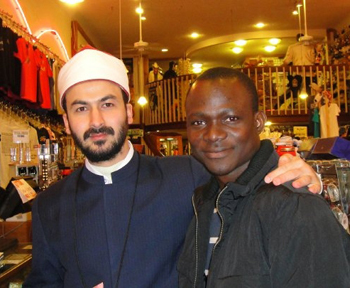
The opportunity to get to know the American people ... has been the most important aspect of my Fulbright program,” says Imam Muhammed Abulezz (left).
”The opportunity to get to know the American people ... has been the most important aspect of my Fulbright program,” says Imam Muhammed Abulezz (left).
A unique Fulbright initiative, developed in partnership with Islam’s oldest university, is building bridges of interfaith understanding, while giving concrete expression to President Obama’s call in Cairo in 2009 for broader engagement between the United States and the Muslim world.
The Islamic Studies Program with Al-Azhar University is the result of collaboration between the Binational Fulbright Commission in Egypt and the administration of Al Azhar University, one of the leading Islamic institutions of higher education in the world.  This program creates opportunities for a handful of students who specialized in Islamic studies at Al-Azhar to travel to and study in the United States each year, familiarizing themselves with American culture, religious practices, and education. Students in the program enroll in U.S. master’s or doctoral programs or pursue research in areas such as comparative religion, Islam in the United States, and Islamic jurisprudence. Equally important are the ample opportunities built into their programs to experience American society and culture with a particular focus on the diversity in religious practice in America. The first three ISP students began their studies in fall 2009, three followed in fall 2010 and three more are expected to arrive next fall.
“The opportunity to get to know the American people, Americans themselves, has been the most important aspect of my Fulbright program,” says Muhammed Abulezz, who arrived in fall 2009 at the University of Georgia to pursue a master’s degree in religious studies. “It has provided an opportunity to discover that Americans have a lot of values that I like and that exist in my religion, too.”
Similarly, Sami Metwally was drawn to the ISP Fulbright program by the opportunity to get to know America firsthand. His interest stemmed from his work as an editor at IslamOnLine.Net, providing religious counseling to an audience that included American Muslims.
“We hear from the media about the U.S., and people here have impressions about Muslims from Egypt, Libya, and so on, and I thought that coming here would be a great opportunity for me to know more about American society and people, and to give them an idea about Muslims. That’s why I came,” he notes.
Metwally is pleased that his program at Hartford Seminary has enabled him to become “integrated in American society from day one.” Although he is pursuing a master’s degree in Islamic Studies, he has appreciated the many activities organized by his program that relate not just to his course of study, but Islamic-Christian relations and other aspects of interfaith dialogue.
The Fulbright students are contributing to the intellectual and religious life at the institutions that are hosting them, which include Yale University’s Divinity School and the Universities of Georgia, Chicago, and Arizona.  Abulezz is one of the few imams to ever participate in the Fulbright program. He notes that he is often called upon in class to explain Islamic concepts to his classmates: “My professors appreciate that I am from Al-Azhar University and a Fulbrighter at the same time.”
By including several women, moreover, the program is helping to break down stereotypes of women in Islam. Mariam Shehata began a master’s degree program at Yale University’s Divinity School in fall 2010. “When she arrived, the school saw this model of a Muslim woman,” recalls Dr. Sallama Shaker, a visiting professor of Islamic Studies and the Middle East at the school. Shaker, who is her adviser, goes on to explain that this is the first time in the school’s history that it welcomes “a young woman who is wearing a veil and is willing and capable — having graduated at the top of her class — of discussing Islam and engaging in academic discourse about comparative religion.”
The lessons learned are transformative and likely to become part of a bridge-building process that will continue after the students return to Egypt.  “They’ll be able to go back to convey to the young students all their experiences in the United States, which were very positive, and that Islam is not the enemy. This is a very important message,” says Shaker, who is Egyptian.
Meanwhile, Yale has reciprocated, sending a group of American students to Al Azhar in January. Although the exchange visit was cut short by the unexpected political events, organizers hope to be able to plan another trip in the future. Other programs are seeking to reinforce the lines of communications between Americans and Muslim scholars in Egypt. AMIDEAST’s Cairo office recently introduced a special “English for Religious Purposes Program” with support from the U.S. Department of State.  In addition to strengthening the language and cross-cultural communications skills of the 45 participants, it will help to expand the pool of prospective Islamic scholars with the necessary language and cross-cultural communication skills to make the most of this unique Fulbright program.

Should Egypt be a Democracy or a Republic?

OP-ED COLUMNIST

The Politics of Solipsism

The United States, as you know, was founded as a republic, not simply as a democracy. The distinction has been lost over the past few decades, but it is an important one.
Josh Haner/The New York Times
David Brooks
Go to Columnist Page »

David Brooks’s Blog

The intellectual, cultural and scientific findings that land on the columnist’s desk nearly every day.

The Conversation

Conversation
David Brooks and Gail Collins talk between columns.

Readers' Comments

Readers shared their thoughts on this article.
The believers in a democracy have unlimited faith in the character and judgment of the people and believe that political institutions should be responsive to their desires. The believers in a republic have large but limited faith in the character and judgment of the people and erect institutions and barriers to improve that character and guide that judgment.
America’s founders were republicans. This was not simply elitism, a matter of some rich men distrusting the masses. This was a belief that ran through society and derived from an understanding of history. As Irving Kristol put it in a brilliant 1974 essay called “Republican Virtue vs. Servile Institutions,” “The common man is not a fool, and the proof is that he has such modest faith in himself.”
The first citizens of this country erected institutions to protect themselves from their own shortcomings. We’re familiar with some of them: the system of checks and balances, the Senate, etc. More important, they believed, was public spiritedness — a system of habits and attitudes that would check egotism and self-indulgence.
As Kristol points out in the essay, the meaning of the phrase “public spiritedness” has flipped since the 18th century. Now we think a public-spirited person is somebody with passionate opinions about public matters, one who signs petitions and becomes an activist for a cause.
In its original sense, it meant the opposite. As Kristol wrote, it meant “curbing one’s passions and moderating one’s opinions in order to achieve a large consensus that will ensure domestic tranquility.” Instead of self-expression, it meant self-restraint. It was best exemplified in the person of George Washington.
Over the years, the democratic values have swamped the republican ones. We’re now impatient with any institution that stands in the way of the popular will, regarding it as undemocratic and illegitimate. Politicians see it as their duty to serve voters in the way a business serves its customers. The customer is always right.
A few things have been lost in this transition. Because we take it as a matter of faith that the people are good, we are no longer alert to arrangements that may corrode the character of the nation. For example, many generations had a moral aversion to debt. They believed that to go into debt was to indulge your basest urges and to surrender your future independence. That aversion has clearly been overcome.
We no longer have a leadership class — of the sort that existed as late as the Truman and Eisenhower administrations — that believes that governing means finding an equilibrium between different economic interests and a balance between political factions. Instead, we have the politics of solipsism. The political culture encourages politicians and activists to imagine that the country’s problems would be solved if other people’s interests and values magically disappeared.
The democratic triumph has created a nation that runs up huge debt and is increasingly incapable of finding a balance between competing interests. Today, the country faces three intertwined economic challenges. We have to make the welfare state fiscally sustainable. We have to do it in a way that preserves the economic dynamism in the country — that provides incentives for creative destruction. We also have to do it in a way that preserves social cohesion — that reduces the growing economic and lifestyle gaps between the educated and less educated.
These three goals are in tension with one another, but to prosper America has to address all three at the same time.
Voters will have to embrace institutional arrangements that restrain their desire to spend on themselves right now. Political leaders will have to find ways to moderate solipsistic tribalism and come up with tax and welfare state reforms that balance economic dynamism and social cohesion.
Over the past months, there has been some progress in getting Americans to accept the need for self-restraint. With their various budget approaches, the Simpson-Bowles commission, Paul Ryan and President Obama have sent the message that politics can no longer be about satisfying voters’ immediate needs. The public hasn’t bought it yet, but progress is being made.
There has been less progress in getting political leaders to come up with compromises that balance dynamism and cohesion. Republicans still mostly talk about incentives for growth, and Democrats still mostly talk about economic security. The breakthrough, if there is one, will come from the least directly democratic parts of the government, from the Senate or some commission of Establishment bigwigs. It will be enacted when voters realize we need to build arrangements to protect ourselves from our own weaknesses. It will all depend on reviving the republican virtues upon which the country was founded.